

Community Landscape Management Enhances Climate Resilience and Reduces Deforestation Across Seven Municipalities
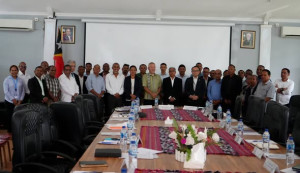
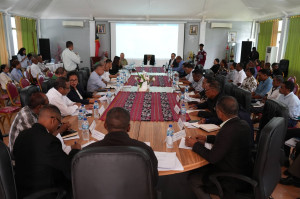
On April 7th, 2026, the Minister of Agriculture, Livestock, Fisheries, and Forestry, Marcos da Cruz, met at his ministry with the Japanese Ambassador to Timor-Leste, Yamamoto Yasushi, and the representative of the Japan International Cooperation Agency (JICA), Fukulmori Daisuke, as part of the 4th meeting of the Joint Coordination Committee for the project “Community-Based Landscape Management for Strengthening Climate Resilience and Reducing Deforestation in Watersheds,” which covers seven municipalities. 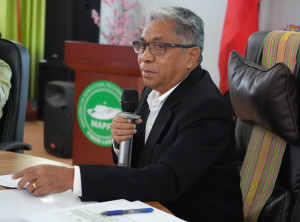
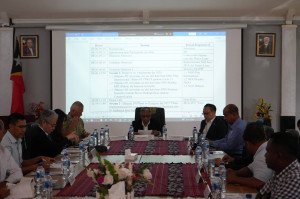
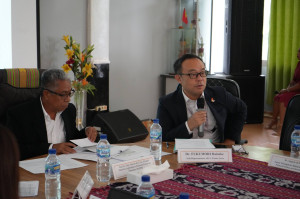
The project, funded by the Green Climate Fund and JICA and supported by the Government, has been underway since 2022 and focuses on 60 villages (suco) across 14 administrative districts, covering four priority watersheds: Mota (river) Comoro, Mota (river) Lacló, Mota (river) Karau Ulun, and Mota (river) Tafara.
As part of this initiative, regulations were developed at the hamlet level to promote the sustainable use of natural resources and to strengthen community-based management. Municipal authorities and the Government approved these regulations. Local committees ensure that their implementation is monitored through regular meetings.
“The project has already delivered tangible benefits to communities by introducing more effective agricultural and land management technologies and practices, including tree planting, compost production, climate-resilient farming techniques, and the rehabilitation of old coffee trees. “These interventions contribute to increased agricultural productivity and strengthened climate resilience,” said Minister Marcos da Cruz.
The Japanese Ambassador highlighted the project’s contribution to strengthening forest and environmental management, with a focus on participatory land use and adaptation to climate change, and emphasised Japan’s support through JICA and its collaboration with implementing partners.
The JICA representative noted that participatory planning for integrated land use has already been carried out in 60 villages, with the remaining areas nearing completion. This has enabled communities to establish land-use rules and to understand the impacts of climate change on their agricultural activities.
Presidents of municipal authorities and directors of municipal agricultural services from the seven municipalities covered by the project also attended the meeting.
The initiative forms part of the Government’s efforts to promote the sustainable management of natural resources and to strengthen the resilience of rural communities in the face of climate change.
Legal Disclaimer:
EIN Presswire provides this news content "as is" without warranty of any kind. We do not accept any responsibility or liability for the accuracy, content, images, videos, licenses, completeness, legality, or reliability of the information contained in this article. If you have any complaints or copyright issues related to this article, kindly contact the author above.
